
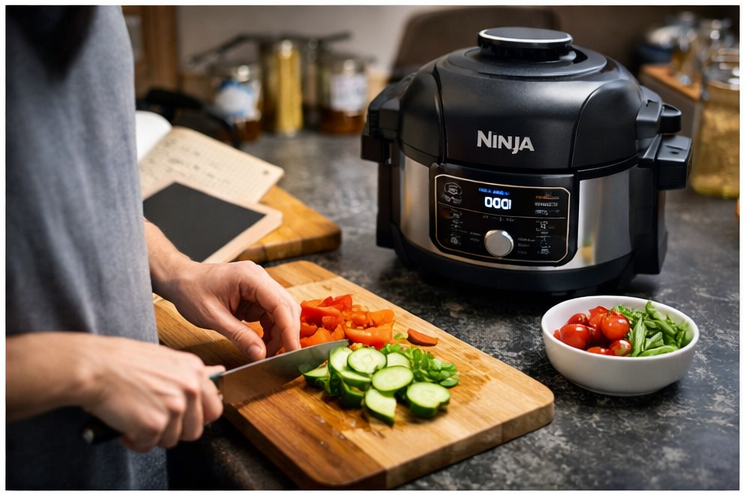
Over the past few months, I have been trying to be more intentional about how I approach my health and daily routines. Part of that effort has involved cooking more meals at home.
At first, the goal was simple: eat better, save money, and become a little more self-sufficient in the kitchen. But as anyone who has tried to cook regularly knows, the process can quickly become complicated. Recipes require planning. Different dishes require different tools. Cooking times vary, and the number of pots and pans seems to multiply faster than expected.
Somewhere in the middle of this learning curve, I purchased a Ninja Foodi air crisp and pressure cooker.
What initially stood out about the appliance was convenience. A single device capable of pressure cooking, air frying, roasting, and slow cooking seemed like a practical way to simplify meal preparation. Products like the Ninja Foodi are often marketed as multi-function kitchen systems that combine several cooking methods into one appliance, reducing the need for multiple tools in the kitchen.
But after looking more closely at how the product is marketed, something else became noticeable.
The appliance is not really designed for just one type of person. Instead, it quietly speaks to several different groups of consumers at once.
One Product, Multiple Motivations
Market segmentation refers to the practice of dividing a broad market into smaller groups of consumers who share similar needs or behaviors. When companies do this effectively, the same product can be positioned differently depending on who they are speaking to.
The Ninja Foodi is a good example.
One clear segment is busy professionals and families. For this group, the main value of the appliance is efficiency. Marketing often emphasizes the ability to cook meals quickly while reducing the number of dishes involved.
Another group includes people who enjoy experimenting with cooking techniques. The multiple functions allow home cooks to try different methods without needing a kitchen full of specialized equipment.
There is also a segment of health-conscious consumers. Air frying technology is often promoted as a way to achieve the texture of fried food while using less oil.
Finally, the product appeals to individuals interested in simplifying their kitchens. By combining several tools into one appliance, it becomes attractive to people with limited space or those who prefer fewer devices on their counters.
The product itself remains the same. What changes is the reason someone decides to buy it.

Why Segmentation Matters
Looking at the product through a marketing lens reveals several segmentation strategies.
Some elements reflect demographic segmentation, targeting adults responsible for preparing meals in their households.
Other elements suggest psychographic segmentation, which focuses on lifestyle and values. Messaging around efficiency, convenience, and home cooking appeals to consumers who prioritize practicality in their daily routines.
There is also a behavioral element. The product clearly targets people who cook regularly and are searching for ways to simplify that process.
When these approaches are combined, a single product becomes relevant to multiple groups.
A Few Lessons About Segmentation
Watching how this appliance is marketed highlights several principles that matter when companies implement segmentation strategies.
First, segments must reflect real consumer needs. In this case, time constraints, kitchen space, and cooking confidence are everyday challenges many people experience.
Second, segments should be identifiable and reachable. Products like this are frequently promoted through cooking demonstrations, recipe content, and social media platforms where home cooks often search for ideas.
Third, different consumers often respond to different forms of value. Babin and Harris describe consumer value as either utilitarian, which focuses on practical benefits, or hedonic, which relates to enjoyment and experience ( 2022). For some people, the appliance saves time. For others, it makes cooking more enjoyable. In many cases, those motivations overlap.
A Segment Worth Exploring

During this process, another segment became noticeable: people learning how to cook for themselves.
This group might include young professionals, recent graduates, or anyone transitioning into independent living. Many want to cook at home but feel overwhelmed by complicated recipes or the number of tools required.
For this segment, a multi-purpose appliance could be positioned as a starting point. Marketing strategies might focus on simple recipes, beginner guides, and instructional content that helps new cooks build confidence in the kitchen.
Seeing Marketing in Everyday Decisions
What began as a simple purchase during my attempt to cook more meals at home slowly turned into something else: a small lesson in how companies think about consumers.
Most products are not designed for just one type of person. Instead, they are positioned to appeal to several groups, each with their own motivations and expectations.
Once you start noticing these patterns, they appear almost everywhere. Even in something as ordinary as a kitchen appliance.