
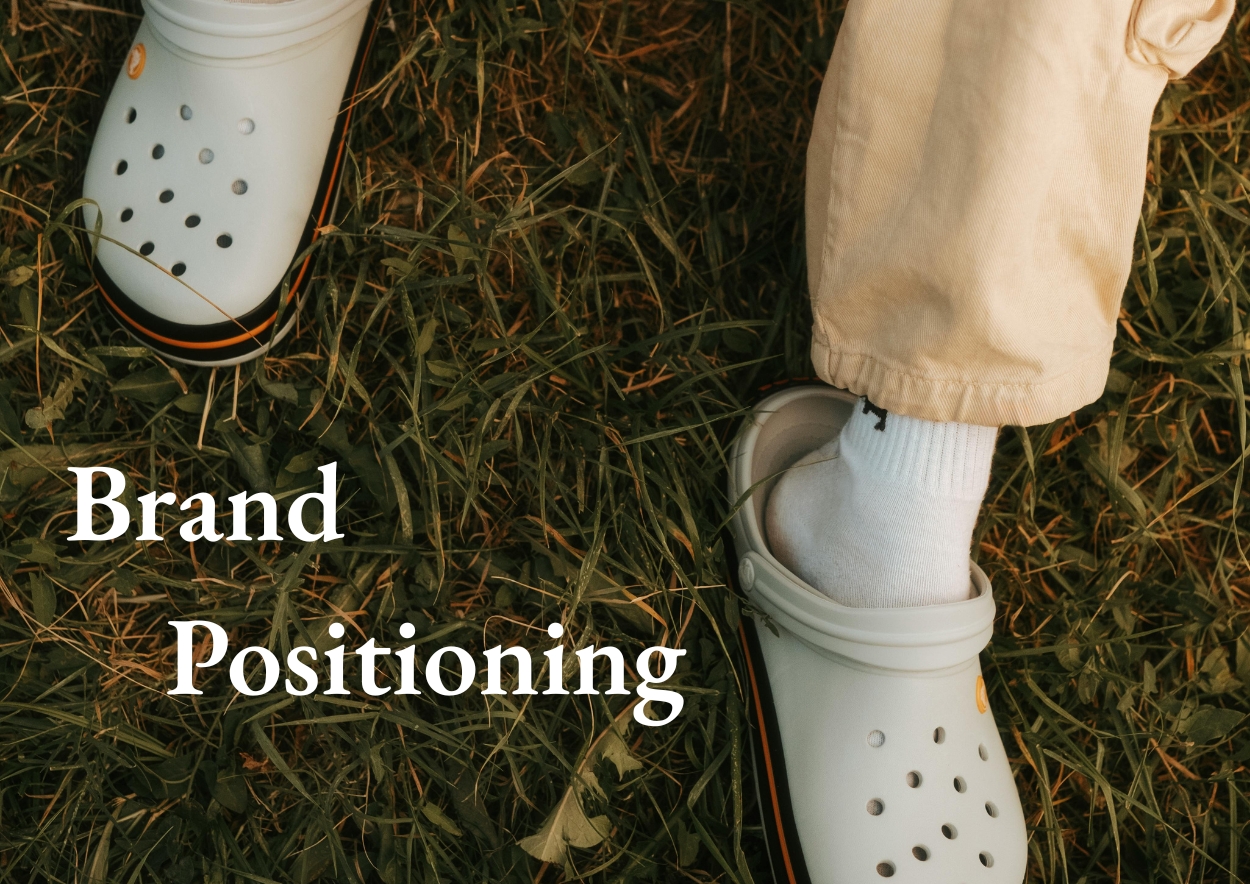
I remember when Crocs first showed up in my school hallways. A few classmates started wearing them, and they got mocked constantly, flamboyant colors, holes punched all over a rubber clog, the whole thing looked more like a slipper than a shoe. I remember thinking the same thing everyone else did: this looks weird, and not in a good way. Looking back now with a marketing lens, Crocs is actually one of the clearest examples I’ve seen of how much a brand’s success or failure comes down to positioning, not the product itself.
Brand positioning, as The Branding Journal explains, describes how a brand differs from its competitors and where it sits in a customer’s mind, an idea first introduced in 1969 by Jack Trout. Branding Strategy Insider adds an important detail to that history: positioning happens in the consumer’s mind whether or not a brand tries to manage it. Trout and Ries argued that if a brand doesn’t actively shape that perception, someone else will shape it instead, competitors, critics, or culture at large.
When Crocs Let the Market Define It
Crocs launched in 2002 as a purely functional shoe built for comfort, adopted early by medical professionals, chefs, and parents at the playground. The brand became so widely mocked that TIME magazine named it one of the 50 worst inventions in 2010. Crocs’ own response at the time was the slogan “ugly can be beautiful,” in an attempt to acknowledge the criticism rather than push back against it.
That slogan is where the positioning strategy actually failed. Rather than defining a clear, distinctive identity in the consumer’s mind, Crocs let the “ugly” label sit at the center of its own messaging. It wasn’t differentiation, it was concession. A brand can’t build strong equity by agreeing with its critics, even if the phrasing sounds clever. The perception controlling the brand at that stage wasn’t comfort or utility, it was embarrassment, and Crocs’ own slogan reinforced that instead of replacing it.
When Crocs Took the Position Back
The turnaround came through a deliberate repositioning strategy, not a product change. Crocs partnered with Balenciaga, a move that shocked the fashion world and forced a second look at a shoe most people had already dismissed. That partnership opened the door to collaborations with Barbie, Levi’s, and McDonald’s, along with adoption by celebrities like Kendall Jenner and Ariana Grande. The results were significant, quarterly sales rose 63 percent at one point, and the company reported a $2.7 billion profit in 2022.
What actually changed wasn’t the shoe. It was the positioning; Crocs allowed to exist around it. Instead of apologizing for being different, the brand leaned fully into individuality, helped along by Jibbitz charms that let every pair be personalized. That shift lines up directly with Crocs’ current mission, to create a more comfortable world for all, paired with the slogan “Come As You Are.” The brand stopped trying to convince people it wasn’t strange and instead made strange the entire point.
What the Name Was Doing All Along
Crocs’ naming strategy deserves credit here too, since it was working in the brand’s favor even during the years the reputation wasn’t. According to Ignyte, evocative names use metaphor and allusion to suggest a brand’s positioning rather than stating its function outright, and Crocs fits that category closely. The name doesn’t describe a clog, it evokes a crocodile, an animal equally at home on land and in water, which mirrors the shoe’s own amphibious versatility and its bumpy, textured look. That kind of name is harder to grasp instantly than a purely descriptive one, but it gives a brand more room to build a story around it later, which is exactly what Crocs eventually did once it decided to control its own narrative instead of reacting to public opinion.
The Lesson Crocs Actually Teaches
Crocs didn’t succeed because the shoe changed. It succeeded because the brand finally took control of the perception surrounding it instead of absorbing whatever the market decided to say. That’s the real argument behind brand positioning, it isn’t about the product’s features, it’s about who gets to define the story, the brand, or everyone else.
Has there ever been a brand you dismissed early on, the way I dismissed Crocs in that school hallway, that later won you over once its positioning actually changed? I’d be curious to know which one, and what actually shifted your perception of it.
References
Andrivet, M. (04 Nov 2016). A simple definition of brand positioning. The Branding Journal. https://www.thebrandingjournal.com/2016/11/brand-positioning-definition
Crocs, Inc. (n.d.). Careers: Who we are. https://careers.crocs.com
Daye, D. (n.d). The origins of brand positioning. Branding Strategy Insider. https://brandingstrategyinsider.com/2017/06/the-origins-of-brand-positioning
Lischer, B. (n.d.). 7 types of brand names (90 examples + name generators). Ignyte. https://www.ignytebrands.com/7-popular-types-of-brand-names
Meharg, K. (20 jan 2025). Do we, millennials… all like Crocs now? What the hell has happened (and why can’t I take mine off…). Capsule NZ. https://capsulenz.com/covet/crocs-do-we-love-them-now